
Compost in 24 hours? Dried waste is not mature compost.
Examine 24-hour compost claims through research on dehydration, mass reduction, biological conversion and maturity.
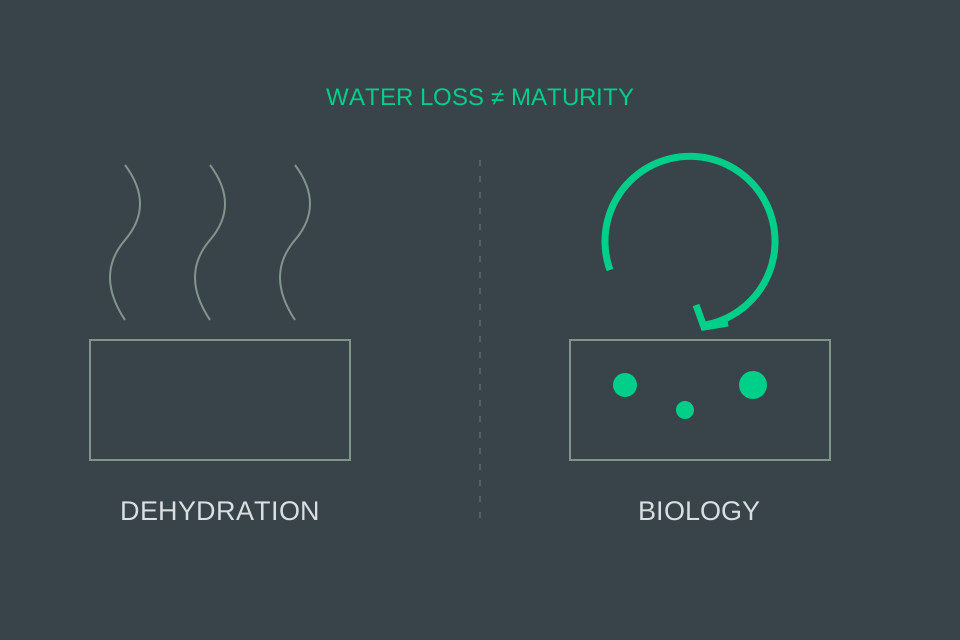
01 / WHAT IS BEHIND A 24-HOUR CLAIM?
Rapid mass reduction should not
be confused with rapid composting.
Heating and grinding can remove water and produce a smaller, dry output. This is dehydration; it does not by itself demonstrate mature compost. EPA distinguishes dried food waste from stable compost and explains the need for further processing. [9]
When “compost in 24 hours” describes a drying cycle, it confuses equipment runtime with biological maturity. A brown, crumbly or lighter material is not sufficient evidence of completed composting. [5] [9]
02 / DIFFERENT PROCESSES
Dehydration removes water.
Composting transforms organic matter.
Microorganisms perform biological decomposition. Air, moisture and temperature management support this activity. A completed drying cycle does not demonstrate completed conversion or curing. [9] [10]
Preparation
Sorting, shredding and any pre-treatment.
Active conversion
Microbial transformation of suitable organic inputs.
Curing
Further stabilisation and use assessment.
Assessed output
Suitability for the intended application.
Conceptual stages can overlap; their sizes do not represent fixed durations. [9] [10]
| Claim | Possible meaning | What it does not establish |
|---|---|---|
| 90% reduction in 24 hours | Water loss and physical change. | Equivalent biological conversion. [5] |
| Output every day | Discharge from a continuously fed system. | A one-day residence time for every newly added particle. |
| A three-day experiment | A result for a particular input and treatment. | The same result for all feedstocks and scales. [1] |
03 / ACADEMIC EVIDENCE
“Cycle complete” is not
the same as “compost ready”.
Dehydration research, device comparisons and maturity tests are read together. Short-cycle reports are included and assessed for what their endpoints actually show. These are not head-to-head product tests under identical conditions.
US Environmental Protection Agency (2021)
Emerging Issues in Food Waste Management: Commercial Pre-Processing Technologies
- Design and material
- US EPA review of commercial food-waste pre-processing, including dehydrators and their end products.
- Reported findings
- Dried food waste is distinguished from stable compost; further biological processing and curing are discussed.
- Interpretation and limitations
- This is an institutional technical report, not a controlled performance test of every machine.
Schroeder, J. T.; Labuzetta, A. L.; Trabold, T. A. (2020)
Assessment of Dehydration as a Commercial-Scale Food Waste Valorization Strategy
- Design and material
- Commercial food-waste dehydration, characterised across sources using 37 parameters.
- Reported findings
- Reported mass reduction was 70–90%; suitably blended output could become feedstock for further composting.
- Interpretation and limitations
- This is not demonstration of mature compost in 24 hours. Water removal and biological transformation must be distinguished.
Voběrková, S. ve arkadaşları (2026)
Comparative evaluation of four household food-waste composting systems for decentralized circular waste management
- Design and material
- Four household systems, three replicates each: GG-02 28 days, Lifetime 64, JORA 103 and Millen 83.
- Reported findings
- The authors report that all final products required further curing.
- Interpretation and limitations
- Chamber volumes, loads, amendments and residence times differed. This is not a controlled 24-hour comparison and cannot be generalised to every device.
Lončarić, Z. ve arkadaşları (2024)
The Evaluation of Compost Maturity and Ammonium Toxicity Using Different Plant Species in a Germination Test
- Design and material
- Plant-residue compost tested with four plant species and two extract dilutions, alongside chemical and respiration measurements.
- Reported findings
- Plant responses to the same compost varied with species and extract dilution.
- Interpretation and limitations
- One germination index is insufficient to establish suitability for all plants or complete stability. Use multiple defined measures.
Pitjamit, S. ve arkadaşları (2025)
Development of a Household Food Waste Composter: QFD Approach and Fertilizer Nutrient Analysis
- Design and material
- A household prototype using automatic temperature, moisture, aeration and odour controls; designed for 1–2 kg/day.
- Reported findings
- The authors report fast processing and favourable nutrient measurements.
- Interpretation and limitations
- The discussion acknowledges possible incomplete stabilisation from nitrite and low pH. Respiration stability and germination verification are not presented. Nutrient content alone is not maturity.
Peticilă, A. G. ve arkadaşları (2023)
Results regarding the 24-hour composts (Oklin) composition and their use as fertiliser
- Design and material
- Food-waste device outputs were mixed with peat/perlite at different rates and tested with parsley and loofah.
- Reported findings
- Some 10% and 20% mixtures gave favourable plant results; responses varied with mixture and species.
- Interpretation and limitations
- The 24-hour duration is attributed to equipment specifications. A complete feed-to-test timeline and standardised respiration stability at 24 hours are not demonstrated. The project was funded by Eutron Invest Romania.
O’Connor, J.; Hoang, S. A.; Bradney, L.; Rinklebe, J.; Kirkham, M. B.; Bolan, N. S. (2022)
Value of dehydrated food waste fertiliser products in increasing soil health and crop productivity
- Design and material
- Dehydrated food-waste products assessed for soil properties and maize/wheat responses.
- Reported findings
- Low application rates could benefit growth; high rates delayed germination and reduced growth.
- Interpretation and limitations
- Effects depend on product and dose. Neither universal harm nor automatic direct-use suitability follows.
Wang, L.; Li, Y.; Li, X. (2024)
Microbe-aided thermophilic composting accelerates manure fermentation
- Design and material
- A 1 kg manure/straw experiment in externally heated 2 L jars. Three selected isolates were tested individually at 1% inoculation, with three replicates per treatment.
- Reported findings
- The authors report shortening from five to three days; FSB24 and FSB30 had germination indices above 90% on day three and favourable wheat growth results.
- Interpretation and limitations
- The initial six-day community experiment and three-day inoculation trial are separate. No direct respiration stability test is reported in the methods. Feedstock, scale and heating limit extrapolation to food waste or commercial machines.
Shahid, M.; Ahmed, W.; Khan, A. B.; Shams, Z. I.; Arif, A. (2024)
Identification of bacterial community in a rapid composting method using 16SrDNA genes sequencing
- Design and material
- Mechanically assisted municipal organic waste treatment with eleven combinations of microbial communities and additives.
- Reported findings
- The abstract reports two combinations completing within three days.
- Interpretation and limitations
- Only the abstract was accessible. Scale, process conditions and maturity verification could not be assessed from full methods.
Cornell Waste Management Institute (t.y.)
Frequently Asked Questions — Cornell Composting
- Design and material
- Cornell technical guidance on compost readiness and curing.
- Reported findings
- Curing follows active decomposition; duration depends on mixtures and operating conditions.
- Interpretation and limitations
- General practical durations are not universal minimum limits for accelerated experimental systems.
04 / BEYOND RUNTIME
Maturity needs more
than one indicator.
Stability concerns remaining biological decomposition potential; maturity concerns suitability for an intended use. Relevant assessment combines biological activity, chemical properties and plant responses under defined conditions. [8] [9] [10]
Biological activityOxygen uptake or carbon dioxide release under controlled conditions.
Plant responseGermination and growth with species, dilution and controls specified.
Chemical profileC/N, ammonium/nitrate, pH and salinity in feedstock and use context.
Intended useRelevant hygiene and unwanted-material assessment.
05 / GREBOTICS
Controlled biological conversion.
Grebotics describes an approach combining gas, compost and chamber temperatures, moisture and heat-exchange data to assess biological phases. AI-assisted control manages conditions supporting bacterial life cycles. Active duration depends on feedstock, mixture and operation; curing and use suitability are assessed separately.
Three-day results have been reported for specific experimental conditions. They do not establish a universal minimum or independently validate Grebotics equipment. [1] [2]
06 / QUESTIONS
Assessing a 24-hour claim.
Why is dried waste not automatically ready compost?
Water removal does not demonstrate sufficient biological stabilisation. Further processing and curing may be needed. [9]
Does a soil-like appearance prove maturity?
No. Colour and particle size do not replace biological, chemical and plant-response assessment. [8]
07 / REFERENCES
Traceable to the original publication.
Targeted literature review, updated 16 October 2026. This is not a systematic review or product certification. Access levels are stated for each source. A process duration alone cannot identify every device as a dehydrator.
- 01Wang, L.; Li, Y.; Li, X. (2024). Microbe-aided thermophilic composting accelerates manure fermentation
10.3389/fmicb.2024.1472922 ↗Full text - 02Shahid, M.; Ahmed, W.; Khan, A. B.; Shams, Z. I.; Arif, A. (2024). Identification of bacterial community in a rapid composting method using 16SrDNA genes sequencing
10.1007/s10532-023-10056-z ↗Abstract only - 03Pitjamit, S. ve arkadaşları (2025). Development of a Household Food Waste Composter: QFD Approach and Fertilizer Nutrient Analysis
10.55003/ETH.420301 ↗Full text - 04Peticilă, A. G. ve arkadaşları (2023). Results regarding the 24-hour composts (Oklin) composition and their use as fertiliser
Original source ↗Full text - 05Schroeder, J. T.; Labuzetta, A. L.; Trabold, T. A. (2020). Assessment of Dehydration as a Commercial-Scale Food Waste Valorization Strategy
10.3390/su12155959 ↗Full text via publisher-indexed content - 06O’Connor, J.; Hoang, S. A.; Bradney, L.; Rinklebe, J.; Kirkham, M. B.; Bolan, N. S. (2022). Value of dehydrated food waste fertiliser products in increasing soil health and crop productivity
10.1016/j.envres.2021.111927 ↗Abstract and university publication record - 07Voběrková, S. ve arkadaşları (2026). Comparative evaluation of four household food-waste composting systems for decentralized circular waste management
10.1007/s11356-026-38301-x ↗Full text - 08Lončarić, Z. ve arkadaşları (2024). The Evaluation of Compost Maturity and Ammonium Toxicity Using Different Plant Species in a Germination Test
10.3390/agronomy14112636 ↗Full text via publisher-indexed content - 09US Environmental Protection Agency (2021). Emerging Issues in Food Waste Management: Commercial Pre-Processing Technologies
Original source ↗Relevant full-report sections - 10Cornell Waste Management Institute (t.y.). Frequently Asked Questions — Cornell Composting
Original source ↗Full page