
Quick answer
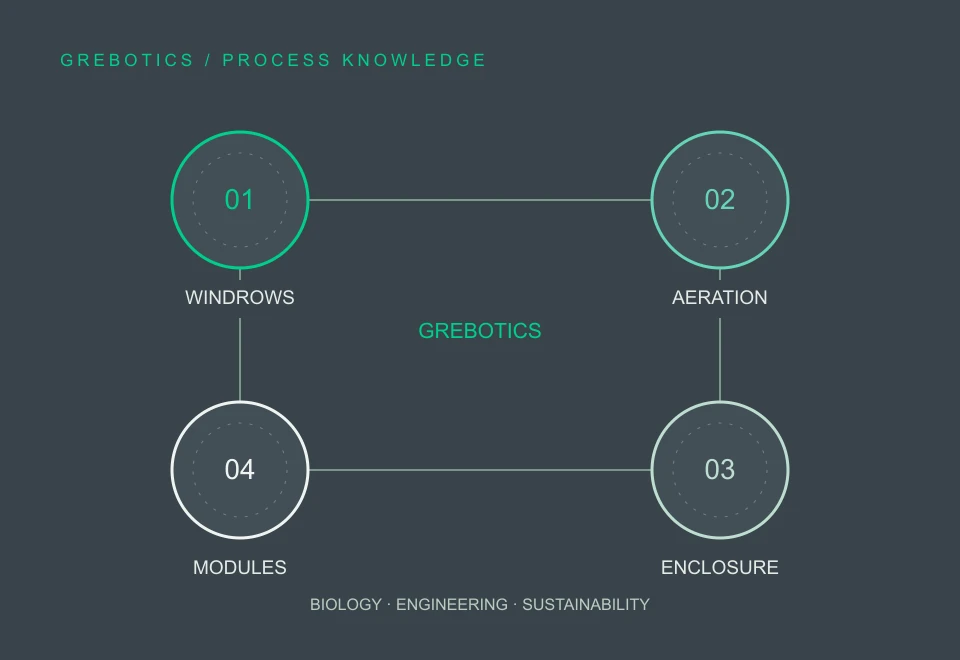
Windrows, aerated systems and enclosed equipment manage biological conversion through different engineering arrangements. The right method depends on feedstock flow and site conditions.
Conventional windrows
Conventional facilities manage material in open or covered areas. Feeding, turning, access routes, rainfall, drainage and output areas need joint planning. Processing time results from mixture and operating conditions, not just a calendar target.
Aerated systems
Air supply can be controlled, but its distribution and feedstock porosity still matter. Design should consider maintenance, air paths and process monitoring as well as fan power.
Controlled compost machine technology ↗Enclosed compost machines
An enclosed chamber provides an environment for process control. S72 machines use a single process chamber. Chamber volume should not be equated to daily throughput: feedstock density and operating cycles matter.
Modular facilities
The GreBotics modern facility concept combines intake and preprocessing, controlled bioreactor modules, enclosed transfer, discharge and packaging. Module count is determined through engineering assessment of flow and target capacity.
| Approach | Control focus | Output | Operating plan |
|---|---|---|---|
| Drying / grinding | Water removal and particle size | Dried residues; not automatically mature compost | Further recovery or biological processing |
| Windrows | Mixture, turning and aeration | Biological conversion depending on conditions | Intake, active processing and curing area |
| Biological compost machine | Sensor-based phase and process conditions | Controlled active conversion; use assessed separately | Feeding, service, discharge and output plan |
| Modular compost facility | Module-level control and enclosed transfer | Biological processing designed for the site flow | Intake, bioreactors, discharge and packaging |
Household or industrial labels alone do not identify a drying or biological process. Compare the actual mechanism and output data.
Practical checklist
- Assess processing and output areas together.
- Compare operating responsibilities.
- Distinguish machine chambers from facility modules.
Sources and scope
These references support general compost science. GreBotics-specific features are identified as product information.